
 GrokImage Team
Grok 4.6 landed on August 12, 2026 — just 35 days after Grok 4.5 — and within a week it became one of the most searched AI models of the month. xAI positions it as a model built for long-running agents and, more interestingly for anyone who makes visuals, "more ambitious interactive and visual work" (xAI announcement).
But let's ask the question that actually matters if you produce images and videos: what does a new reasoning model change about generation? More than you'd think. This guide breaks down what shipped, what the independent benchmarks say, and how to put Grok 4.6-era generation to work today — including how to try Grok Imagine free on GrokImage.ai.
What Is Grok 4.6?
Grok 4.6 is xAI's flagship reasoning model. It keeps the 500,000-token context window of Grok 4.5, adds a new xhigh reasoning level, and accepts text and image input while returning text output.
The headline numbers:
| Spec | Grok 4.6 |
|---|---|
| Release date | August 12, 2026 |
| Artificial Analysis Intelligence Index | 61 (5 points above Grok 4.5) |
| Context window | 500,000 tokens |
| Reasoning levels | low / high (default) / xhigh (new) |
| Input modality | Text + image |
| API price | $2 / M input · $6 / M output |
On the Artificial Analysis Intelligence Index, Grok 4.6's score of 61 matches GPT-5.6 Sol at maximum reasoning and sits one point behind Claude Fable 5 Max (9to5Mac). xAI also reports gains over Grok 4.5 on every listed evaluation, including CursorBench, DeepSWE, FrontierCode, APEX-Agents, and Terminal-Bench.
Under the hood, the gains come from a longer supplemental post-training run — curated model-generated reasoning data, an improved optimizer, SFT trajectories regenerated by Grok 4.5, and reinforcement learning across agent environments spanning coding, kernel optimization, web development, and even computer-aided design.
Grok 4.6 vs Grok 4.5: What Actually Changed
The easiest way to understand this release: same base, smarter behavior. Independent vision benchmarks from Roboflow make the delta concrete:
| Vision task | Grok 4.5 | Grok 4.6 | Change |
|---|---|---|---|
| Overall (6-task average) | 64.3% | 67.8% | +3.5 pts |
| Counting | 55.4% | 70.3% | +14.9 pts |
| Object detection | 18.0% | 20.2% | +2.2 pts |
| Data extraction | 83.5% | 84.5% | +1.0 pts |
| Visual reasoning (high effort) | 59.6% | 61.6% | +2.0 pts |
| OCR | 92.5% | 92.0% | ~flat |
| Avg speed per sample | 14.3s | 7.4s | ~2x faster |
| Avg cost per sample | $0.0077 | $0.0069 | ~10% cheaper |
Three takeaways for creators:
- It sees images much better. Counting accuracy jumped nearly 15 points — fewer mangled details when the model analyzes a reference photo before editing it.
- It's roughly 2x faster per visual task at slightly lower cost, which compounds fast in batch workflows.
- Better visual understanding means better edits. When you say "remove the third person from the left" or "make the sign say OPEN," a model that can actually count and read is far less likely to butcher your image.
If you've compared generation tools before, you know this understanding step is exactly where most models fail. We cover this failure mode in detail in our Midjourney vs GrokImage.ai comparison.
Why Image People Should Care About a Reasoning Model
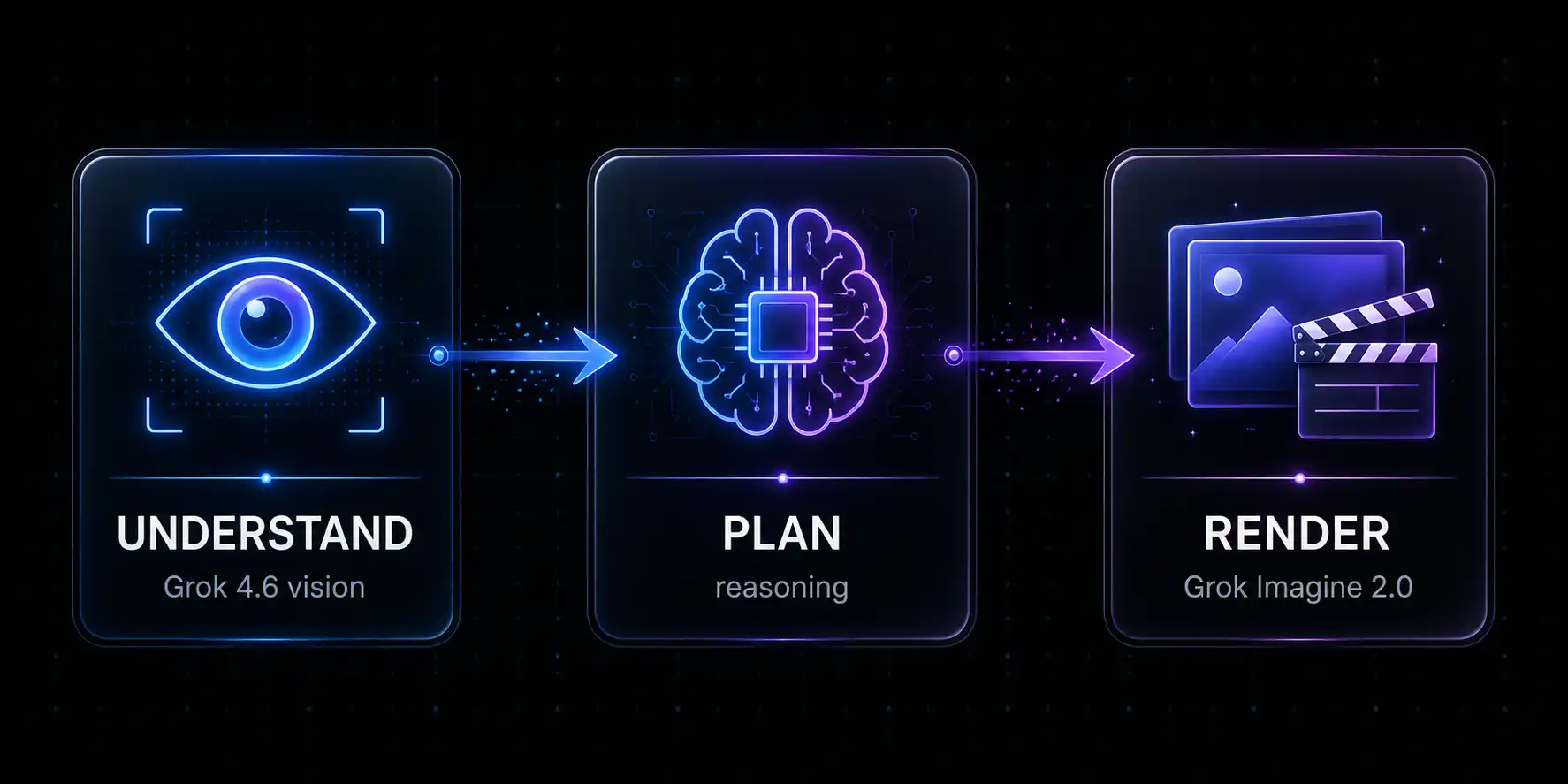
There's a subtlety worth understanding: Grok 4.6 itself is a reasoning and vision-understanding model — text and image in, text out. The pixel production happens in Grok Imagine, xAI's generation engine. The two now form a pipeline:
Grok 4.6 (understand & plan) → Grok Imagine Image / Video (render)xAI states that Grok 4.6 delivers stronger first passes on visual and interactive projects than Grok 4.5 — given a concrete idea, it can establish a visual language in one pass and keep iterating. In practice, that shows up in generation workflows as:
- Reference images parsed more accurately — the model "reads" your photo (objects, text, layout) before transforming it
- Multi-step edit instructions held across turns without losing the plot
- Self-verification — xAI observed the model checking its own output before moving on, which means fewer half-finished edits
This is exactly the loop that powers modern image-to-image workflows: understand → plan → render → verify.
Grok Imagine Image 2.0: Region-Level Editing Is Here
While Grok 4.6 grabbed the headlines, xAI quietly shipped something bigger for image makers. Grok Imagine Image 2.0 arrived on August 7, 2026 as the new Quality Mode in Grok Imagine on web and mobile (MagicShot's rundown). It brings:
- Region-level editing — change specific parts of an image instead of regenerating the whole thing
- Five-image reference blending — combine composition, style, and subject references from up to 5 images in one generation
- Leaderboard results — the #2 spot on two major public image leaderboards, right behind OpenAI's GPT Image 2
Combined with the Grok 4.6-era understanding layer, this moves Grok's pitch from "generate something wild" to "edit exactly what you mean."
Grok Imagine 2.0 is available on GrokImage.ai today — you can generate with Grok Imagine 2.0 here, alongside the original Grok Imagine that's free to start.
Grok Imagine Video: 1080p, Voice Cloning, 7-Reference Scenes
On the video side, 2026 has been a breakout year for Grok (Tech Times). The current stack:
- Native 1080p output (added August 1, 2026) — no more post-hoc upscaling for full HD
- Text-to-video — Aurora synthesizes a starting frame from your prompt, then animates forward, no reference frame required
- Voice cloning & consistency — up to 3 audio references keep a character's voice stable across scenes
- Seven image references — lock character, environment, and object consistency across generations
- Arena-verified quality — Grok Imagine Video 1.5 took #1 on the Image-to-Video Arena in May 2026 (Elo ~1,231), passing Seedance 2.0 and Google Veo
- Native audio in one pass — sound effects, ambience, and dialogue generated together with the frames
Clips run up to 15 seconds at 24fps with audio baked in — built for social content, product teasers, and animating still photos.
Pricing and Limits in 2026 (Read This Before You Budget)
This is the part most older guides get wrong. The landscape changed in March 2026 (Fello AI's pricing guide):
- The free tier no longer includes image or video generation on grok.com and X
- Entry point is now a paid plan (~$10/month for basic generation)
- Hit your tier's 720p video cap and outputs silently drop to 480p
- The old "$150/month free API credits" data-sharing program has disappeared from xAI's docs
For the Grok 4.6 API itself: $2 per million input tokens, $6 per million output tokens, with a fast variant at 2x — frontier-tier intelligence at a discount versus similarly-scored models.
This is exactly why searches for "grok image generation free" spiked in 2026. Creators want the Grok look — photorealism, legible text rendering, fast iteration — without the paywall roulette. On GrokImage.ai, Grok Imagine generation starts free (guests get a free generation, no credit card), and premium models like Grok Imagine 2.0 and Nano Banana Pro unlock with a plan — see the pricing page for the full breakdown.
How to Generate Images with Grok 4.6 Right Now
You have three realistic paths:
Option 1 — Official channels. Grok Imagine on grok.com/imagine or the Grok mobile apps. Quality Mode (Image 2.0) and 1080p video are here, but you'll need a paid subscription, and weekly usage pools apply.
Option 2 — The API. grok-4.6 for the reasoning layer, grok-imagine-image / grok-imagine-video for rendering. Prepaid billing, no free credits — best for developers building pipelines. Our Grok model page tracks the current model lineup and capabilities.
Option 3 — Generate right here. Start creating Grok-style images on GrokImage.ai — free to start, no subscription decoding required to understand what you get:
Generate a Grok-style image now — turn a prompt into a finished visual in seconds. Start generating → Already have an image to transform? Try image-to-image →
Prompt Tips for Grok-Style Visuals
Whatever tool you use, these patterns consistently get more out of Grok-generation (for a deeper dive, see our complete guide to AI image prompts):
- Write exact text IN CAPITALS when you need legible text in-image — Grok models render uppercase most reliably
- Name the aspect ratio explicitly (1:1, 16:9, 9:16) rather than hoping the model infers it from your description
- Stack references deliberately — one image for subject, one for style, one for composition. Image 2.0's multi-reference blending rewards separation of concerns
- For edits, describe the region first, then the change ("the sign on the right → make it say OPEN") — region-level understanding is the new superpower
- For video, lead with camera language ("tracking shot", "overhead macro", "cinematic close follow") — motion descriptions shape the first frames Aurora synthesizes
FAQ
Is Grok 4.6 free?
The Grok 4.6 API is paid ($2/M input, $6/M output tokens). On grok.com and X, image and video generation require a paid subscription as of March 2026 — the free tier no longer includes generation. Third-party tools like GrokImage.ai still offer free ways to generate with Grok Imagine models.
Can Grok 4.6 generate images?
Grok 4.6 itself analyzes and reasons about images (text + image in, text out). Image and video rendering is done by Grok Imagine, which now runs Image 2.0 with region-level editing and up to 1080p video.
Is Grok 4.6 better than Grok 4.5?
Yes, across the board. It scores 61 vs 56 on the Artificial Analysis Intelligence Index, wins 4 of 6 independent vision benchmarks, and is roughly 2x faster per visual task at slightly lower cost.
How does Grok 4.6 compare to GPT-5.6 and Claude?
On the Artificial Analysis Intelligence Index, Grok 4.6 (61) matches GPT-5.6 Sol at maximum reasoning and trails Claude Fable 5 Max by one point — at a significantly lower API price.
What is Grok Imagine Image 2.0?
xAI's latest image generation model (shipped August 7, 2026), available as Quality Mode in Grok Imagine. It adds region-level editing and five-image reference blending, and ranks #2 on two major public leaderboards behind GPT Image 2.
Will there be a Grok 4.7?
Reportedly yes — investor commentary points to a larger ~2.1-trillion-parameter Grok 4.7 within weeks, with Cursor and SpaceX data in pretraining. Treat exact timing as unconfirmed.
The Bottom Line
Grok 4.6 isn't just another benchmark bump. Paired with Imagine Image 2.0 and 1080p video, it marks the moment Grok's visual stack got practical: a model that truly sees what's in your image, an engine that edits regions instead of rerolling dice, and video output you can actually publish.
Ready to create? Generate your first Grok-style image →